


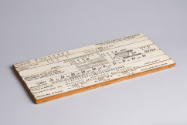
Barth's gear slide rule
Datecirca 1902
Inventory Number1990-5-0005
ClassificationSlide Rule
Subject
Maker
Carl G. Barth
1860-1939
User
Stuart E. Freeman
Associate Name
Frederick W. Taylor
1856-1915
Cultural Region
Place of Origin
Dimensions2.2 × 45.7 × 8.9 cm (7/8 × 18 × 3 1/2 in.)
Material
DescriptionWood rule with four slides, stacked vertically, faced with off-white paper on top and blue paper on bottom. The top and bottom slides are fixed; the second and third slides move from left to right.
The top slide is printed with three scales for "Number of Teeth in Gear." On the bottom edge of the slide, towards the left, is a scale for "Radial Flank System," with values ranging from 12 to 100. To the right of this scale is a second, for "20° Involute System," carrying values from 12 to 300. Above these two scales is a scale for "Cycloidal and 15° Involute System," again carrying values from 12 to 300.
The second slide is divided horizontally in two. Printed on the top edge of the left half is a scale for "Circular Pitch," with values descending from 5'' to 0.5''. On the bottom edge of the same (left) half is a scale for "Face," carrying values from 1'' to 10''. The right half of the second slide is printed with a scale for "Number of Teeth per Inch of Diamet.," with values ranging from 5/8 to 6. On its bottom edge is a scale for "Face," carrying values from 1'' to 10''.
Printed on the top edge of the third slide is a scale for "Permissible Stress on Material at 0 Velocity," with values (in pounds) descending from 50,000 to 500. On the bottom edge of the same (third) slide is a scale for "Circumferential Velocity in Feet per Minute," with values descending from 5000 to 0.
A single scale, for "Tangential Working Load on Gear," is printed on the top edge of the fourth slide. It carries values (in pounds) from 50 to 10,000.
On the the reverse face of the rule are written instructions for using this instrument to determine the strength of a bevel gear. Adjacent are two figures. To the text's immediate right is a drawing indicating which measurements of a bevel gear are used in the bevel gear-spur gear conversion formula. To the far right is a graph showing both the relative strengths of bevel and spur gears with the same pitch and face, and the relative strengths of bevel gears of two different faces.
The top slide is printed with three scales for "Number of Teeth in Gear." On the bottom edge of the slide, towards the left, is a scale for "Radial Flank System," with values ranging from 12 to 100. To the right of this scale is a second, for "20° Involute System," carrying values from 12 to 300. Above these two scales is a scale for "Cycloidal and 15° Involute System," again carrying values from 12 to 300.
The second slide is divided horizontally in two. Printed on the top edge of the left half is a scale for "Circular Pitch," with values descending from 5'' to 0.5''. On the bottom edge of the same (left) half is a scale for "Face," carrying values from 1'' to 10''. The right half of the second slide is printed with a scale for "Number of Teeth per Inch of Diamet.," with values ranging from 5/8 to 6. On its bottom edge is a scale for "Face," carrying values from 1'' to 10''.
Printed on the top edge of the third slide is a scale for "Permissible Stress on Material at 0 Velocity," with values (in pounds) descending from 50,000 to 500. On the bottom edge of the same (third) slide is a scale for "Circumferential Velocity in Feet per Minute," with values descending from 5000 to 0.
A single scale, for "Tangential Working Load on Gear," is printed on the top edge of the fourth slide. It carries values (in pounds) from 50 to 10,000.
On the the reverse face of the rule are written instructions for using this instrument to determine the strength of a bevel gear. Adjacent are two figures. To the text's immediate right is a drawing indicating which measurements of a bevel gear are used in the bevel gear-spur gear conversion formula. To the far right is a graph showing both the relative strengths of bevel and spur gears with the same pitch and face, and the relative strengths of bevel gears of two different faces.
Signedface, top right: Made for Stuart E. Freeman / by Carl G. Barth.;
on back: Carl G. Barth.
Inscribedon top: Strength of Spur Gears / According to Wilfred Lewis.
Curatorial RemarksRecords indicate that Barth was working in Philadelphia in 1902;
Date based on publication of <i>American Machinist</i> article (see primary sources);
Similar in function to other rectangular gear rules, though this instrument was evidently made for a specific client and has a different arrangement of variables, see 1990-4-0011 1990-4-0012;
Similar in function to circular gear slide rules dated 1902, see 1990-4-0033, 1990-5-0003.
FunctionFor calculating the strength (in load in pounds) of spur or bevel gears.
For a spur gear, the user first moves the second slide to the left or right such that the value of the pitch of the gear (using the left- or right-hand scale, depending on whether the pitch is circular or diametral, respectively) coincides with the number of teeth of the gear (on the appropriate scale, according to gear type, on the top slide) in question.
Then, holding the second slide in place, he moves the third slide to left or right such that the value of the permissible static stress on the material aligns with the value of the face of the gear. For a gear with a circular pitch, he uses the "Face" scale printed on the left-hand side of the bottom edge of the second slide. For a gear with a diametral pitch, he uses the "Face" scale printed on the right-hand side.
The user next locates the value of the circumferential velocity of the gear on the bottom edge of the third slide. The coincident value on the "Tangential Working Load on Gear" indicates the strength of the gear.
For a bevel gear the user first multiplies the number of teeth in the gear by the tooth's length, then divides by the tooth's height. He next uses the slide rule to calculate the strength of a spur gear with the number of teeth equal to this new value, and pitch and face values equal to those of the bevel gear. Finally, he uses the graph on the right-hand side of the reverse face of the rule to convert this spur-gear strength into bevel-gear strength.
For a spur gear, the user first moves the second slide to the left or right such that the value of the pitch of the gear (using the left- or right-hand scale, depending on whether the pitch is circular or diametral, respectively) coincides with the number of teeth of the gear (on the appropriate scale, according to gear type, on the top slide) in question.
Then, holding the second slide in place, he moves the third slide to left or right such that the value of the permissible static stress on the material aligns with the value of the face of the gear. For a gear with a circular pitch, he uses the "Face" scale printed on the left-hand side of the bottom edge of the second slide. For a gear with a diametral pitch, he uses the "Face" scale printed on the right-hand side.
The user next locates the value of the circumferential velocity of the gear on the bottom edge of the third slide. The coincident value on the "Tangential Working Load on Gear" indicates the strength of the gear.
For a bevel gear the user first multiplies the number of teeth in the gear by the tooth's length, then divides by the tooth's height. He next uses the slide rule to calculate the strength of a spur gear with the number of teeth equal to this new value, and pitch and face values equal to those of the bevel gear. Finally, he uses the graph on the right-hand side of the reverse face of the rule to convert this spur-gear strength into bevel-gear strength.
ProvenanceThe papers and slide rules of Carl G. Barth and his son, J. Christian Barth, were transferred to the Baker Library of the Harvard Business School by J. Christian Barth in 1961.
The slide rules were transferred from Harvard Business School to the Collection of Historical Instruments in 1980.
Historical AttributesThis is part of a set of slide rules for machine shops designed by Carl G. Barth under Frederick Winslow Taylor's system of scientific management. Given the characteristics of a particular machine and a depth of cut, for example, a shop manager could quickly calculate the most efficient speed and feed settings using one of Barth's speed and feed slide rules. Other objects in the collection include slide rules for helical springs, belts, and gears, as well as jigs for making slide rules.


Carl G. Barth
Date: copyright 1902
Accessories: storage box; instruction booklet in instrument file
Object number: 1990-4-0033

Carl G. Barth
Date: copyright 1902
Accessories: storage box; instruction booklet in instrument file
Object number: 1990-5-0003




William R. Osgood
Date: 1900-1940
Accessories: Brown leather case with flap closure, for storage
Object number: 1997-1-1926

Carl G. Barth
Date: circa 1910
Object number: 1990-5-0019

Carl G. Barth
Date: circa 1910
Object number: 1990-5-0018


